Showing posts with label chartering terminology. Show all posts

November 4, 2020

Deadweight Tonnage (DWT)


What is Deadweight Tonnage?

The word ‘ton’ in shipping can denote both weight and capacity. Loaded displacement tonnage is the actual weight of the ship and cargo. Light displacement tonnage is the actual weight of the ship. The difference between the loaded displacement and the light displacement is the weight that the ship can actually carry and is known as the Deadweight Tonnage (DWT).

October 29, 2020

Bale Capacity and Grain Capacity - what is the difference?


Ship bale and grain capacity measurements are provided by shipyards for dry cargo ships. Ship bale and grain capacities are used for measuring cargo space availability for bulk or non-bulk cargoes. 

Ship bale and grain capacity measurements show the actual volumes available for cargo in numbers. Grain capacity is the space that is available for liquid-type cargo, like bulk grain, which can flow into every corner. Bale capacity is the space that is available for bagged or baled cargoes. Generally, a ship’s bale capacity is about 7–10% less than grain capacity. 

October 21, 2020

Arrived ship

The Laytime

It is clearly important to determine when laytime commences since this is the key to the division of responsibility for the time spent at the load and/or discharge port. Most charterparties require the owners to serve a notice of readiness at load or discharge port stating that the vessel is ready in all respects for cargo operations, the notice of readiness constitutes the contractual step which is required to trigger the commencement of laytime. Due to this, charterparties usually contain provisions which stipulate when notice of readiness may be contractually served and when laytime commences once notice of readiness has been validly served.

October 14, 2020


Stowage Factor (SF) is the density of the cargo in the ship’s hold. In the shipping business, Stowage Factor (SF) is a very important piece of information. 

Due to the ship’s cubic capacity, a ship has only a limited volume (space) in her holds. In some cases:

  • Light Cargo: the ship’s holds are full before all the ship’s deadweight cargo capacity is utilized 
  • Heavy Cargo: full deadweight capacity can be reached with space still available in holds, but that space is unusable

In the shipping business, some historic measurement systems are still in use, for example, variations of the old English system (imperial system) of weights and measures are still frequently used for Stowage Factor (SF) – cubic feet to one ton (ft3/ton). 

October 10, 2020

Reversible Laytime

In voyage chartering, permitting charterers to add up the laytime allowed for loading and discharging is called Reversible Laytime. In other words, any time saved (or exceeded) at the load port can be carried forward to the discharge port. Depending on the drafting of the relevant clause, charterers may only have a limited period of time for deciding whether to reverse.

May 15, 2015

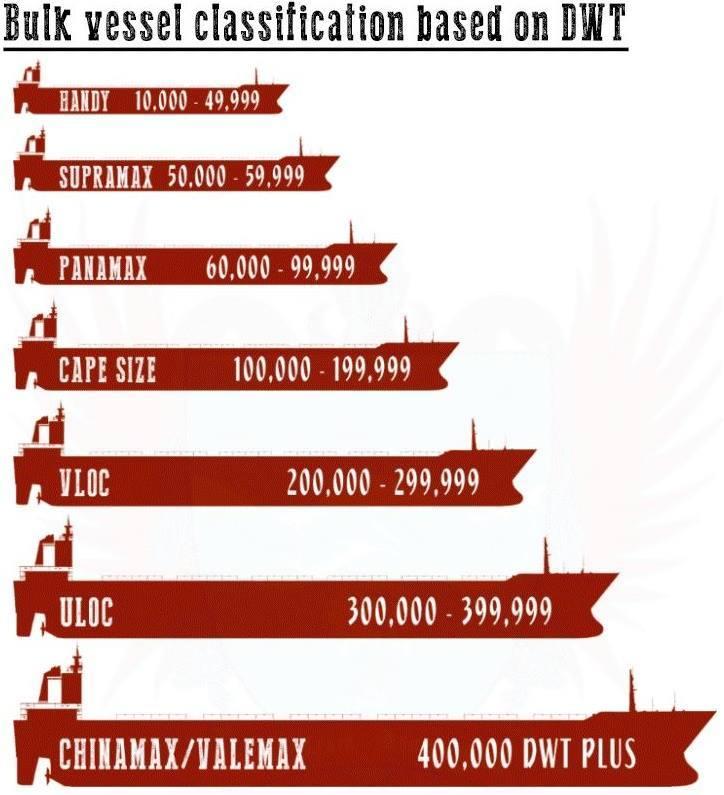
Types of bulk carriers - part 2 (briefly)

In our previous post we have learned much about the types of bulk carriers. However in practice all one needs to know is always less, than they write in books. Thus, this article is here to show you all you need to know about classification of bulk carriers according to their size.

April 20, 2015

Types of bulk carriers

I would like to enlighten the basics, which will understand the whole picture. And another good book will help me out. It's named "Bulk carrier practice" by Captain J Isbester. It was written in 1990's, so the information might be outdated, but the basics are still the same:


February 16, 2015

What is a Charter Party?

The most general determination of a Charter Party term is:
A contract by which an entire ship, or some principal part thereof, is let to a merchant for the conveyance of goods on a determined voyage to one or more places.
Charter parties could be divided in the following basic categories:

February 13, 2015

What is laytime?

The definition of LAYTIME is :
‘the period of time agreed between the parties during which the Owner will make and keep the vessel available for loading or discharging without payment additional to the freight’.
or
'the time allowed to the charterers to load/discharge cargo in return for payment of freight to the owners. If the charterers are unable to load/discharge cargo within this allowed period, they will be obliged to pay demurrage or detention to compensate the owners for their loss of use of the vessel'

February 11, 2015

Safe port and safe berth

Today I have faced with a question, which is simple on the one hand, but is rather difficult on the other hand. The question was "may the particular port and berth be considered as safe port and safe berth?"

THE New York Produce Exchange (NYPE) charter party (as revised in 1946) is a typical time charter. It imposes an obligation on the charterer to ensure that the vessel is employed "between safe port and/or ports". A similar duty is imposed in a voyage charter party. But, in many voyage charter parties, load and disports are identified by name, which gives rise to different considerations.

February 1, 2015

Shipping terminology and acronyms / Glossary


А

AA
Always Afloat
AAAA
Always Accessible Always Afloat
AAOSA
Always Afloat or Safe Aground. Condition for a vessel whilst in port
AARA
Amsterdam-Antwerp-Rotterdam Area
ABAFT
Toward the rear (stern) of the ship. Behind.
ABOARD
On or within the ship
ABOVE DECK
On the deck (not over it - see ALOFT)
ABT
About
ADA
All details about
ADCOM
Address Commission
ADDENDUM
Additional chartering terms at the end of a charter party
AFSPS
Arrival First Sea Pilot Station (Norway)
A/E
Accept/Except