Showing posts with label operations. Show all posts
November 4, 2020
Deadweight Tonnage (DWT)
What is Deadweight Tonnage?
The word ‘ton’ in shipping can denote both weight and capacity. Loaded displacement tonnage is the actual weight of the ship and cargo. Light displacement tonnage is the actual weight of the ship. The difference between the loaded displacement and the light displacement is the weight that the ship can actually carry and is known as the Deadweight Tonnage (DWT).
October 21, 2020
Arrived ship
The Laytime
It is clearly important to determine when laytime commences since this is the key to the division of responsibility for the time spent at the load and/or discharge port. Most charterparties require the owners to serve a notice of readiness at load or discharge port stating that the vessel is ready in all respects for cargo operations, the notice of readiness constitutes the contractual step which is required to trigger the commencement of laytime. Due to this, charterparties usually contain provisions which stipulate when notice of readiness may be contractually served and when laytime commences once notice of readiness has been validly served.October 14, 2020
Stowage Factor (SF) is the density of the cargo in the ship’s hold. In the shipping business, Stowage Factor (SF) is a very important piece of information.
Due to the ship’s cubic capacity, a ship has only a limited volume (space) in her holds. In some cases:
- Light Cargo: the ship’s holds are full before all the ship’s deadweight cargo capacity is utilized
- Heavy Cargo: full deadweight capacity can be reached with space still available in holds, but that space is unusable
In the shipping business, some historic measurement systems are still in use, for example, variations of the old English system (imperial system) of weights and measures are still frequently used for Stowage Factor (SF) – cubic feet to one ton (ft3/ton).
October 10, 2020
Reversible Laytime
In voyage chartering, permitting charterers to add up the laytime allowed for loading and discharging is called Reversible Laytime. In other words, any time saved (or exceeded) at the load port can be carried forward to the discharge port. Depending on the drafting of the relevant clause, charterers may only have a limited period of time for deciding whether to reverse.
May 10, 2016
Check list for Operations dept.
One of the main things to do, when a voyage is fixed and you operate vessel on time charter is drafting a check list for the voyage. Though it's not a very hard question, a check list may hardly be standardized, because it's structure depends on a particular voyage. However we may divide it into blocks and try to make universal rules for these blocks. Here's the example of blocks for an easy usual voyage basis 1/1 without passing channels.
February 2, 2016
October 16, 2015
Draft alterations depend on water density
Good day
It happened that I forgot the formula for the calculation of vessel's draft at different water density, though I searched the Internet and found nothing in English. So I decided to translate the article, which I found in Russian.
When the vessel passes from one water basin to another, the salinity (seawater density) changes. It's very useful to know the way vessel's draft will change. And for the determination of vessel's draft delta we will turn to physics.
It happened that I forgot the formula for the calculation of vessel's draft at different water density, though I searched the Internet and found nothing in English. So I decided to translate the article, which I found in Russian.
When the vessel passes from one water basin to another, the salinity (seawater density) changes. It's very useful to know the way vessel's draft will change. And for the determination of vessel's draft delta we will turn to physics.
May 15, 2015
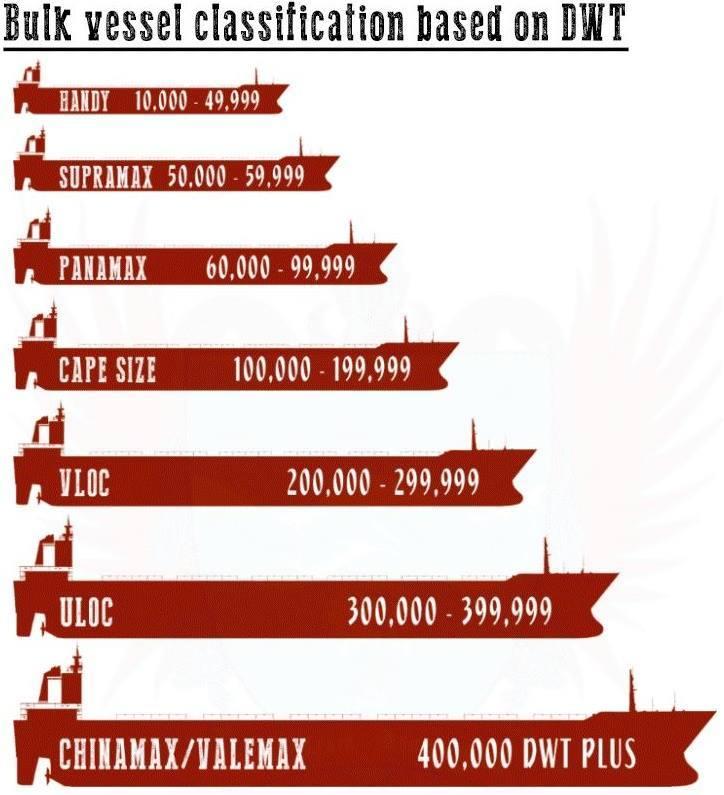
Types of bulk carriers - part 2 (briefly)
In our previous post we have learned much about the types of bulk carriers. However in practice all one needs to know is always less, than they write in books. Thus, this article is here to show you all you need to know about classification of bulk carriers according to their size.
April 20, 2015
Types of bulk carriers
I would like to enlighten the basics, which will understand the whole picture. And another good book will help me out. It's named "Bulk carrier practice" by Captain J Isbester. It was written in 1990's, so the information might be outdated, but the basics are still the same:
April 14, 2015
CP proformas
Earlier I have wrote about what is a Charter Party. And now it's time to make a list of different CP proformas for easy reference. The list will be kept here and it will be updated from time to time.
April 10, 2015
Letters of indemnity
What is a 'Letter Of Indemnity'
In general Letter of Indemnity (LOI) is a letter guaranteeing that contractual provisions will be met, otherwise financial reparations will be made. The principle behind a Letter of Indemnity is the guarantee that losses will not be suffered if certain provisions of a contract are not met.
What is a 'Letter of Indemnity' in shipping
In case one party, which is providing the LOI fails to meet some provisions of the contract, which are also stated in the LOI, it will have to make financial repatriations, or cover financial losses of the other party, which is accepting the LOI connected with this breach. There are various situations in which a Shipowner or a Disponent Owner may be offered a Letter of Indemnity. In each case, this offer will usually be made in return for the Owner taking on some non-contractual risk.
Sometimes Owners request the LOI to be countersigned by Shippers and Shippers' bank together with Charterers' signature and stamp as a confirmation that goods are paid and Shippers do not mind of cargo discharging or changing the receiving party, or any other changes. However, that is not something that is requested very often.
Types of 'Letters of Indemnity'
Each situation, when there is a need in providing the LOI may totally differ from another. However, there are some types, that are most common and often used in shipping practice. These are LOI for:
- non presentation of BsL at discharge port;
- production of clean BsL (for shipment of unclean cargo);
- discharge and delivery of cargo at another port;
- switch of BsL;
The LOI is issued, when Owners are to be indemnified in one of the above-mentioned situations. And the possibility of any of above is usually stated in the governing Charter Party. In case, the Charter Party does not allow, for example, switch of BsL, then Owners have rights to refuse the switch and accordingly refuse to accept relevant LOI from Charterers.
March 15, 2015
Delivery clause - Time Charter Party
February 25, 2015
Stowage Factor of general cargoes
February 16, 2015
What is a Charter Party?
The most general determination of a Charter Party term is:
A contract by which an entire ship, or some principal part thereof, is let to a merchant for the conveyance of goods on a determined voyage to one or more places.Charter parties could be divided in the following basic categories:
February 13, 2015
What is laytime?
‘the period of time agreed between the parties during which the Owner will make and keep the vessel available for loading or discharging without payment additional to the freight’.or
'the time allowed to the charterers to load/discharge cargo in return for payment of freight to the owners. If the charterers are unable to load/discharge cargo within this allowed period, they will be obliged to pay demurrage or detention to compensate the owners for their loss of use of the vessel'
February 11, 2015
Safe port and safe berth
Today I have faced with a question, which is simple on the one hand, but is rather difficult on the other hand. The question was "may the particular port and berth be considered as safe port and safe berth?"
THE New York Produce Exchange (NYPE) charter party (as revised in 1946) is a typical time charter. It imposes an obligation on the charterer to ensure that the vessel is employed "between safe port and/or ports". A similar duty is imposed in a voyage charter party. But, in many voyage charter parties, load and disports are identified by name, which gives rise to different considerations.
February 9, 2015
Stowage Factor of bulk cargoes
February 4, 2015
Oil prices
First of all, let's find out why
did the price of oil keep falling during the last seven months.
Back in June 2014, the price of Brent
crude was up around $115 per barrel. As of January 23, 2015, it had fallen by
more than half, down to $49 per barrel:
February 1, 2015
Shipping terminology and acronyms / Glossary
А
А
|
AA
|
Always Afloat
|
AAAA
|
Always Accessible Always Afloat
|
AAOSA
|
Always Afloat or Safe Aground. Condition for a vessel whilst in port
|
AARA
|
Amsterdam-Antwerp-Rotterdam Area
|
ABAFT
|
Toward the rear (stern) of the ship. Behind.
|
ABOARD
|
On or within the ship
|
ABOVE DECK
|
On the deck (not over it - see ALOFT)
|
ABT
|
About
|
ADA
|
All details about
|
ADCOM
|
Address Commission
|
ADDENDUM
|
Additional chartering terms at the end of a charter party
|
AFSPS
|
Arrival First Sea Pilot Station (Norway)
|
A/E
|
Accept/Except |
Subscribe to:
Posts (Atom)